Commercial Ovens
The backbone of the hot line. Exploring the variants of thermal processing equipment.
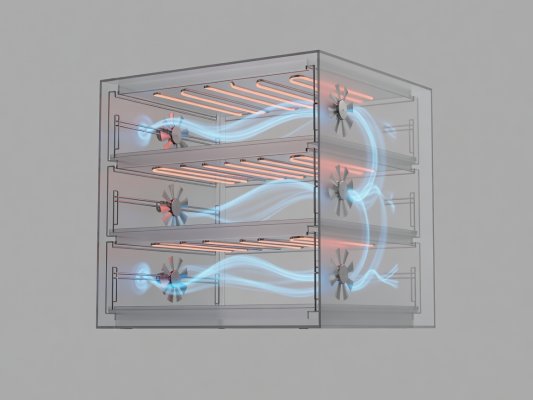
Convection and Combination Systems
Traditional radiant heat relies on natural thermal updrafts. In contrast, convection ovens employ motorized fans to forcibly circulate heated air throughout the chamber. This forced circulation disrupts the stationary thermal boundary layer surrounding the food product, yielding a 25-30% reduction in processing time and ensuring uniform coloration.
The evolution of this concept is the Combi-Oven (Combination Oven). These units inject algorithmic precision into the process, allowing operators to control not just temperature and time, but absolute humidity levels. By utilizing both dry convection heat and high-density steam injection, a combi-oven can poach, roast, smoke, and bake within the exact same footprint, reducing the need for multiple specialized appliances.
Heavy-Duty Ranges and Planchas
The foundation of sauté and pan-based work is the commercial range. Structural integrity is paramount; these units are constructed with cast-iron grates capable of supporting immense weight while resisting thermal warping under constant high-BTU output.
A standard residential burner outputs approximately 7,000 to 12,000 BTUs (British Thermal Units). In stark contrast, an industrial open burner on a heavy-duty range outputs between 30,000 to 40,000 BTUs per burner. This rapid energy transfer is critical for recovery time—the speed at which a pan returns to searing temperature after cold product is introduced.
Flat-top grills and planchas operate on a different thermal principle, providing a massive, unified zone of consistent conductive heat. Constructed from thick steel plate (often 3/4" to 1" thick) to prevent buckling, they offer unmatched utility for high-volume diner-style operations and specialized searing.
← Return to Systems Overview