Stainless Surfaces
The foundation of workflow efficiency and sanitation control.
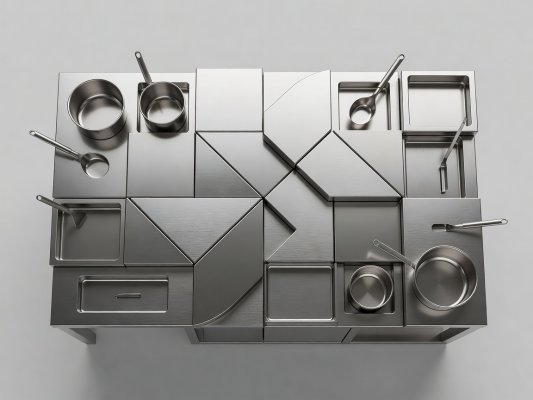
The Importance of Gauge and Grade
Not all metal is equal in an industrial setting. The standard for food-contact surfaces is Type 304 stainless steel. This specific alloy contains 18% chromium and 8% nickel, providing exceptional resistance to the acidic corrosion caused by tomatoes, citrus, and powerful chemical sanitizers.
Equally critical is the gauge (thickness) of the steel. In metalworking, a lower gauge number indicates thicker metal.
- 18-Gauge: Entry-level commercial. Suitable for light prep, sandwich stations, and low-impact tasks. Prone to denting under heavy loads.
- 16-Gauge: The industry standard. Durable enough for general butchery, equipment stands, and heavy daily use.
- 14-Gauge: Heavy-duty specification. Used in high-impact zones, institutional kitchens, and for tables supporting heavy machinery like dough mixers.
Ergonomics and Modular Flow
A static prep table is a missed opportunity. Modern kitchen schematics utilize modular units fitted with heavy-duty casters (wheels). This allows the kitchen floor plan to be reconfigured dynamically based on the menu or service style—transitioning from a linear assembly line for lunch service to a centralized island for evening plating.
Integrated features, such as welded sinks, undershelves, and marine edges (raised borders to contain liquid spills), transform a simple table into a self-contained workstation, drastically reducing the physical steps a chef must take during a shift.
← Return to Systems Overview